Christian and Nationalist IS a Christian Nationalist

Updated: Aug 12
In this short video clip, a man asks Mr. Kirk how he reconciles his brand of Christianity and uses the term Christian Nationalist. Mr. Kirk replies he doesn't identify as a Christian Nationalist but as a Christian and a Nationalist. Sorry, but that IS a Christian Nationalist. In this video Mr. Kirk was trying to make an argument that Scripture justifies Christian Nationalism.
The Video posted on Instagram by Adamtylerfree
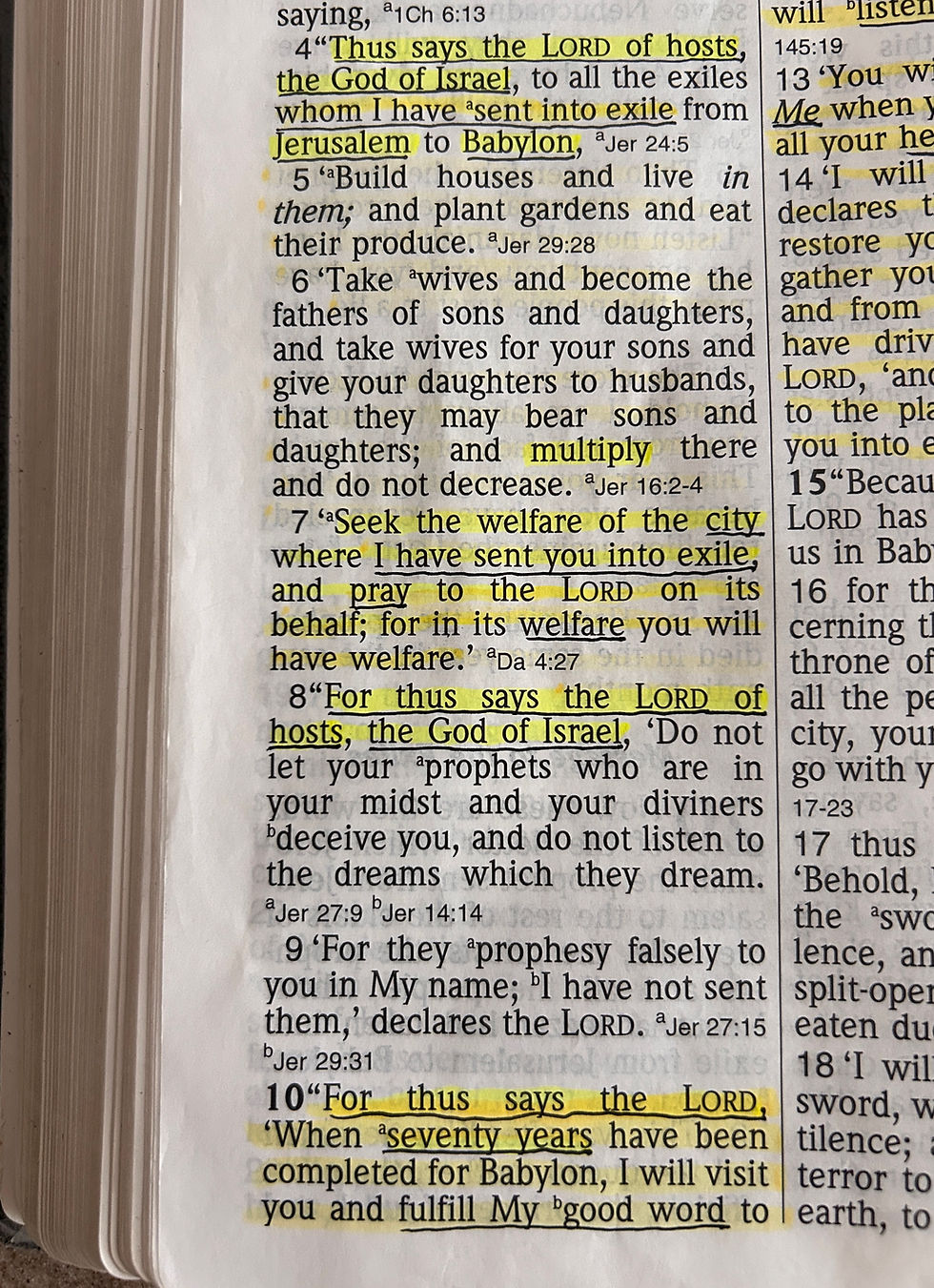
The man asking the question was interrupted but I believe he was then asking something like "Where in the Scriptures does a Christian [justify a Nationalistic world view?]" Immediately Mr. Kirk answers and misquotes Jeremiah 29:7 and he took it out of context of the surrounding chapter. "Seek the welfare of the city where I have sent you into exile, and pray to the Lord on its behalf; for in its welfare you will have welfare." Please read the first half of Jeremiah 29 in your Bible. Even if Mr. Kirk had quoted this verse correctly, it is not an argument for nationalism. It is a case for returning to God and obeying Him.
By this time in world history where Jeremiah was quoted, God had already judged the nation of Israel in 722 B.C. with the brutal Assyrians and He had judged the nation of Judah in 586 B.C. with the brutal Babylonians. God scattered the remnant. (The remnant being those who still loved, trusted and obeyed the LORD.) This scattering is the Diaspora and it served a purpose in God's redemptive plan. The scattering, mentioned by Moses in Deuteronomy 28:64, fulfills one of God’s curses on them if they broke the covenant. (Read Deuteronomy 28 for the curses but also read about the blessings for keeping the covenant.) God’s people were in exile because they had done evil in God’s sight. God “sent” them there (Jeremiah 29:4,7). Of course they were to pray for the welfare of Babylon. (And by the way, Babylon was the capital “city" of the territory/world power of Babylonia. Babylon was not a "nation".) Praying for others is consistent with all of Scripture. God’s people are to love even their enemies and to pray for those in authority over them. The remnant of God’s people who survived God's judgments on Israel and Judah were not a physical "nation" from the year 586 B.C. throughout the millennia to come. My point being of this history lesson is they weren't a nation trying to govern themselves in a godly way. They were people in exile in a foreign city. God was telling them in these circumstances, in this time, pray for the welfare of these pagan people and you will have welfare from doing that. God hears our prayers. He acts on our prayers. We are blessed for our care of others. That's the take-away here.
Then Mr. Kirk starts mentioning many prophets. The prophets were sent to warn Israel and Judah to repent and return to God. The northern nation of Israel and the southern nation of Judah worshipped idols, were prideful, and did social injustice. They broke the covenant with God by exploiting others, taking pride in sin, confusing moral standards, being conceited and perverting justice. They cared more about wealth and power. God sent them many prophets to warn them and He was slow to anger. The prophets told the Hebrew people these are the good deeds God wants you to do – pursue social justice, resist oppressors, and promote the interests of the vulnerable. These are consistent with all of Scripture where we are told to put others before ourselves. The prophets told them (and us) how to act as His people, the behavior which would please our God. I like to remember the prophet Micah telling us what God expects of all people – to do justice, to love kindness, and to walk humbly with God (Micah 6:8).
Moses did not write Deuteronomy to set up a government. That totally misses the point of this very important book of the Torah. (The Torah is the first five books of the Bible.) Yes, Deuteronomy records what happened right before they entered the Promised Land and they became the nation of Israel. Moses reminds them of the covenant between the Lord and them. They agreed to keep this covenant. He reminds them of the Mosaic Law.
At this point Mr. Kirk says, "The Bible is explicitly a political text among other things." This is an absolutely ridiculous statement. The main point of Deuteronomy is not about setting up a government. It is about loving and obeying God in all we do. There are blessings to obeying the covenant and curses for disobedience. The Mosaic Law given in Deuteronomy has to be understood in light of the series of redemptive covenants God made with His people. Today we are under a new covenant and this fact cannot be omitted. Christians do not have to adhere to the civil and ceremonial aspects of the Mosaic Law. However, moral law always stands because God is holy and He does not change. All of this is discussed in the New Testament - our freedom in Christ/ the Law is our tutor to lead us to Christ/ Jesus fulfilled the Law. Whether we must obey the Mosaic Law or not was decided at the Council of Jerusalem in A.D. 49 as recorded in Acts 15. The Torah does contain laws for how their nation was to govern themselves and treat each other and other nations. We can gain applicability from some of these things. But to say "The Bible is explicitly a political text among other things" is totally off track and misses the profound meaning of the biblical text.
The man asking Mr. Kirk the original question about Christian Nationalism was basically saying at this point, 'Whoa, you need to tie this to the New Testament.' And he was absolutely correct. The new covenant fulfills the old covenant. It does not replace the first covenant and the Scripture in the New Testament should be viewed in light of the Old Testament Scripture. The entire Bible is the word of God. The new covenant is how all nations will be blessed. It fulfills the covenant God made with Abraham. That is the redemptive plan right there. It always was.
Mr. Kirk then mentioned Jesus told us the greatest commandment was to love the Lord our God with our whole being as recorded in the Shema, Deuteronomy 6:4-9 and to love our neighbor as ourselves as recorded in Leviticus 19:18. Jesus does tell us to love God with our whole being and love others as ourselves. Yes, the apostle Paul tells us to pray for our leaders in 2 Timothy 2:1-2. Many times in Scripture we are told to pray for our leaders, and it makes no difference whether they are good leaders or bad leaders, or the leaders of our country or another country. We are to pray for them. These are true statements about how Christians should act in the world, but do these verses give us any kind of directive for Christian Nationalism in any way? I don't see a link.
But here is the part of the video which really got me. When Mr. Kirk refers to Matthew 16:18, he says the word “ekklēsia” should not be translated “church”, but to “government structure.” The Bible does translate the word “ekklesia” to “church” in 113 instances and to “assembly” in 3 instances. We know the biblical definitions of many key words in Scripture are different than the secular definitions of those words. We recently studied this in Romans when we looked at the word “flesh”. Other words where the biblical definition is different than the secular definition are: hope, faith, peace, glory, redemption,... We also studied ekklēsia when we studied Acts and we were trying to define ‘What is the church?’ If you go to Blue Letter Bible (a site often used by ministers and scholars), then to Matthew 16:18 and click on tools, go to Strong’s definition and usage, and you will understand why the word is translated to “church.” Not only is Mr. Kirk wrong, but he also seems surprised by the fact it is translated “church”. The man asking the original question was correct - every Bible version says “church”. The 100 people who worked on the Christian Standard Bible version all had PhDs in biblical fields and deemed it is best translated “church”. Mr. Kirk did not have a college education and has not been trained in the translation of ancient Koine Greek. Who should we believe on this?
Mr. Kirk talked very fast, talked over and interrupted this man, and throws in some Scripture verses to make a point. However, the point he was trying to make - that we should be a Christian nation - wasn't made. Perhaps the way he was presenting his argument is because he was a fairly new Christian. In 2020 and before that he claimed he was a secular humanist. Then he became a Christian although I don't know his testimony. Tragically we are unable to see how his spiritual journey and knowledge would have progressed.
It appears to me as if Mr. Kirk was coached to memorize a few talking points about Christian Nationalism. A person may talk fast and with authority, seeming like they are knowledgeable. They may throw in just enough Christian-ese to sound believable. But we must analyze what they say for worthiness. Some of what Mr. Kirk said was true. Some was very misleading - "church" should be translated "government structure" and the Bible is explicity a political text. It is our place to be good students of God’s word and to discern when we are hearing sound teaching and when things don't quite add up.
Mr. Kirk's last statement was absolutely true. "Why should we not care about changing government to be more Christ-like?" We absolutely should! We want our leaders to be moral people of character who love the Lord and and love others. However, Scripture does not call us to become a Christian nation. Mr. Kirk couldn't make a sound argument for Christian Nationalism because the argument can't be made. Instead Scripture calls us to live as Christians where we are. That is a profound distinction. We are to be Christ-like in our sphere of influence. We are to live as salt and light as Mr. Kirk stated. We are to pray for others.
God is concerned about the condition of our hearts. Do we love Him and others? Are we humble? Do we do justice to others? Are we kind? Do we help the vulnerable? Christian Nationalism totally misses the point of each person is made in God’s image, the Gospel is for everyone of every nation, that Christianity is an inclusive religion, that God wants no one to perish, and Christians should exhibit the nine fruit of the Spirit. The Gospel does not spread by making a nation Christian. The kingdom of God spreads by Christians acting Christ-like. How do we act Christ-like? You love the Lord, your God with all your heart, and with all your soul, and with all your mind. You love your neighbor as yourself. You do justice. You love kindness. You walk humbly with God.
Examine what Mr. Kirk said in this video. Read Scripture for yourself and know what it says. Take the time to look up the verses he references for yourself. Read with 20/20 vision (which humorously conveys the idea to read 20 verses before and 20 verses after the verse - not literally 20/20 exact verses, but enough to read the verse in context of the biblical text.) Be discerning. Own your faith.


Comments